Ben Cera Says His Claude Bill Hit $1M a Month. The Real Story Is in the Margins.
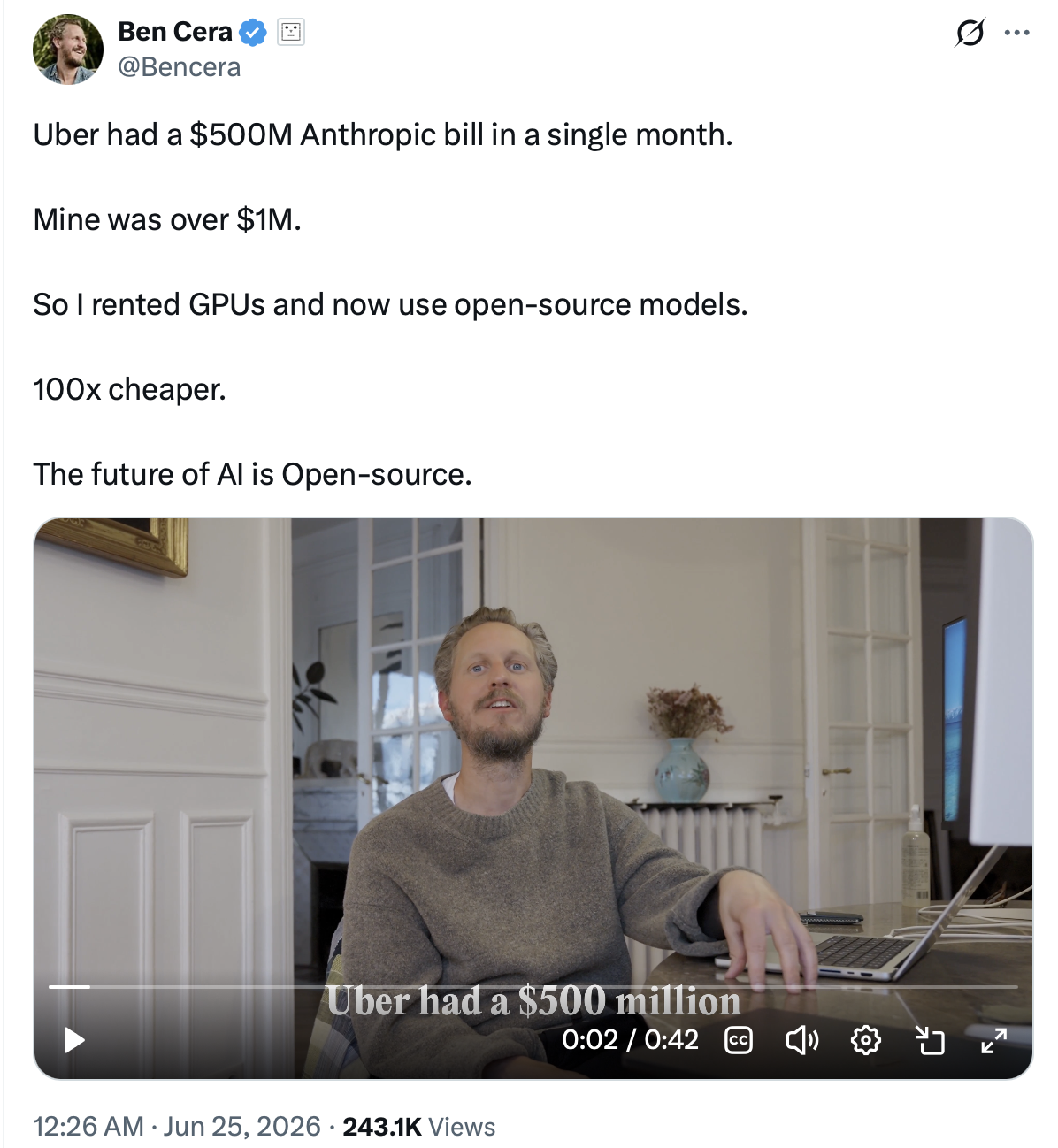
This morning Ben Cera (@Bencera), the solo founder behind the AI company Polsia, posted a tweet that has already cleared 240,000 views:
Uber had a $500M Anthropic bill in a single month. Mine was over $1M. So I rented GPUs and now use open-source models. 100x cheaper. The future of AI is Open-source.
It is a perfect piece of founder content: a jaw-dropping number, a relatable villain (runaway AI costs), and a tidy moral (open-source wins). It is also worth slowing down on, because once you do the arithmetic, the punchline changes.
The parts that check out
Let me be fair before I'm critical. Polsia is a real company, not a meme. Cera raised roughly $30M at a $250M valuation in May 2026 from a genuine syndicate — Sound Ventures, True Ventures, Vaynerfund and others. He isn't a first-timer either: he spent about five years as an early operator at Travis Kalanick's CloudKitchens and previously co-founded Hutch, which raised around $17M. The company reports nearing $10M in annual recurring revenue with a headcount of one. Whatever you think of the hype, the cap table is real.
So the question isn't "is this a scam." It's "does the viral tweet survive contact with the company's own numbers." It mostly doesn't.
The comparison is built on a misattributed figure
Start with the setup. The "$500M Anthropic bill in a single month" was not Uber. That figure comes from an AI consultant who described an unnamed enterprise client to Axios — a company that reportedly forgot to put spending limits on employee licenses. It has never been confirmed by any named firm. Uber's actual, separate story is that it burned through its entire 2026 AI budget by April after rolling Claude Code out to thousands of engineers.
Two different stories, stapled together to make the comparison land harder. It's a small thing, but it sets the tone: precision is not really the point of the post.
The number that matters isn't $1M — it's the ratio
Here's the sharp version. If Polsia's ARR is around $10M, that's roughly $833,000 of revenue per month. A model bill "over $1M" in a single month means Cera was spending more on inference than the entire company earned. And independent write-ups peg Polsia's real subscription ARR closer to $4.6M — about $383K a month — with the rest made up of one-off purchases and pass-through ad spend. On those numbers, the Claude bill was two to three times monthly revenue.
Either way, the headline writes itself, and it isn't the one he wrote: for a stretch, the core product was running at a deeply negative gross margin. That's not a story about Anthropic being expensive. It's a story about a business that cost more to operate than it brought in.
"100x cheaper" is also a confession
Renting GPUs and serving open-source models can genuinely cut inference costs. But 100x is a number to be skeptical of — it tends to quietly ignore GPU idle time, the engineering and ops overhead of self-hosting, and the quality drop when you swap a frontier model for a smaller open one. A "one-person company" now also running its own inference fleet is doing real, unglamorous infrastructure work that the solo-founder narrative conveniently omits.
And notice what the tweet concedes. "I switched to save 100x" is the same sentence as "my unit economics didn't work until last month." For a product already carrying a 2.0-star Trustpilot rating, with the large majority of businesses created on it abandoned shortly after launch, trading frontier quality for cheaper open-source output is a bet, not a free lunch. (The brand name itself doesn't help the optics: Polsia is "AI slop" spelled backwards — something Cera says is intentional.)
The takeaway
None of this makes Polsia fraudulent. It's a real, well-funded experiment in whether one person plus a swarm of agents can run a software company. But the viral tweet is marketing, not a P&L. The interesting question was never whether his Claude bill hit seven figures. It's whether a product that costs more to run than it earns — and then switches to cheaper models to survive — is a preview of the future or just a very well-capitalized search for a business model.
Open-source may well be cheaper. That, by itself, doesn't make the math work.
The part that's personal
I'm not writing this from the cheap seats. I'm in the same arena Ben is — burning AI tokens trying to build something sustainable, the kind of small business that eventually buys enough freedom to spend my days on my own projects. And let me say it plainly: I respect what he's attempting. Steering a real, revenue-generating company essentially solo, on the back of a swarm of agents, is hard, lonely work, and the hustle is genuine. The difference is I'm doing it without a $30M raise, without Sound Ventures on the cap table, without the network that turns a tweet into a quarter-million views. My runway is whatever last month's revenue beat last month's costs. I feel every token.
Which is exactly why this one sticks. When there's no cushion, the math isn't a vibe — it's the whole game, and you learn quickly that a number that doesn't reconcile is a number about to hurt you. I can't make Ben's reconcile. A company that only raised in May 2026, posting a seven-figure monthly model bill against an ARR somewhere between $4.6M and $10M, wrapped in a tidy "the future is open-source" moral — that's less a trajectory than a trajectory-shaped piece of content. Something doesn't add up, and I think it's worth saying so out loud rather than just retweeting the big number.
And here's the part I keep turning over: he didn't need to. He has the funding and the network most of us are still clawing for. So what's the compromise that makes an already well-capitalized founder round the corners of his own story on a public timeline? If performing the numbers — rather than simply earning them — is the price of admission to where he is, it's a price I'd rather not pay.
So, genuinely, good luck to him. I hope the open-source bet pays off and the margins turn real. But I'll take the slower road where the arithmetic actually holds, and post the boring, true version of my numbers when I get there. That's the only kind of success worth keeping.